If your family is from Appalachia, the Carolinas, Virginia or Tennessee - and has always described itself as Scotch-Irish, or sometimes Irish, or sometimes Scottish, depending on who you asked - you are not alone in finding the family history difficult to untangle.
The story really is complicated.
The Scots-Irish, also known as the Ulster Scots, became one of the most significant immigrant communities in American history, yet their origins are often poorly understood. Presidents Andrew Jackson, James K. Polk and James Buchanan all had Ulster Scots ancestry. So did many of the settlers who moved into the American interior during the 18th and 19th centuries.
The surnames can be distinctive - McCullough, Patterson, Armstrong, Wilson, Boyd, Crawford, Hamilton, Montgomery and Logan - and many of these names appear in clusters across counties such as Antrim, Down, Tyrone and Derry in Northern Ireland, as well as Ayrshire and Galloway in south-west Scotland.
To trace this ancestry properly, it helps to understand what actually happened: where these families came from, why they moved, and how that history affects both your research and the way you plan a trip.
Who Were the Ulster Scots?
The story begins in the early 17th century, when the English Crown, under King James I - who was also James VI of Scotland - established the Plantation of Ulster.
Following the departure of several Gaelic Irish lords in what became known as the Flight of the Earls, the Crown began transferring land in parts of Ulster to settlers from Britain. From around 1610 onwards, thousands of Scottish and English settlers arrived in counties including Antrim, Down, Derry, Tyrone, Fermanagh and Armagh.
Many of the Scottish settlers came from the south-west of Scotland - particularly Ayrshire, Galloway and the Borders - drawn by the availability of land and the relative ease of crossing the North Channel. At its narrowest, the distance between south-west Scotland and the north-east coast of Ireland is only around 20 miles. On a clear day, Scotland can be seen from parts of the Antrim coast.
The settlers brought their Presbyterian faith, Scottish surnames and many aspects of Scottish culture with them. Over time, they developed a distinct identity within Ulster, separate from both the Gaelic Irish population and the English settlers.
They established Presbyterian congregations, maintained close community networks and farmed land that had previously belonged to other communities.
Then, within a few generations, many began to leave again.
Why Did the Ulster Scots Leave?
There was no single reason.
Rising rents placed increasing pressure on tenant farmers. The Test Act of 1704 imposed restrictions on Presbyterians seeking public office and holding certain positions. Poor harvests during the early 18th century added to the economic difficulties facing many families.
From around 1718 onwards, significant numbers of Ulster Scots began emigrating to North America, and the movement continued throughout much of the 18th century.
Many initially settled in Pennsylvania, where religious tolerance made it an attractive destination. From there, families moved south and west along routes such as the Great Wagon Road, through the Shenandoah Valley and into Virginia, the Carolinas, Georgia and the territory that would later become Kentucky and Tennessee.
They brought their Presbyterian faith, Scottish surnames and a culture shaped by two migrations: from Scotland to Ulster, and from Ulster to America.
This is the community that became known in America as the Scotch-Irish.
And it is why tracing this ancestry can involve records in two countries - and sometimes three distinct sets of archives.
Where the Records Are - and Why the Research Can Be Complicated
Tracing Ulster Scots ancestry means moving between Scottish, Northern Irish and American records. Knowing which records belong where is one of the first challenges.
The Scottish side
If you can trace your family back to Scotland - which some families can, although many cannot - the Scottish side of the research follows the same path as other Scottish genealogy.
Start with ScotlandsPeople, Old Parish Records, census records and relevant local archives, particularly in areas such as Ayrshire, Galloway and the Borders.
The Scottish records may allow you to establish a parish, identify earlier generations and work backwards towards the family’s departure for Ulster.
The Northern Irish side
The Ulster chapter of the story is held primarily in Northern Ireland.
The Public Record Office of Northern Ireland (PRONI) in Belfast is the main repository for historical records relating to Northern Ireland. Its collections include church records, estate papers, tithe books, census material and many other sources. A substantial amount can be searched online through the PRONI eCatalogue.
The Presbyterian Historical Society of Ireland, also in Belfast, is particularly important for Ulster Scots research. It holds records from Presbyterian congregations, some dating back several centuries.
For many Ulster Scots families, Presbyterian records are especially valuable because they reflect the churches their ancestors actually attended.
The gaps in the records
Northern Irish genealogy also has its limitations.
Some records were lost during the destruction of the Public Record Office in Dublin in 1922, while earlier research often depends heavily on surviving church registers, estate records and sources such as Griffith’s Valuation.
These can be remarkably useful when they survive, but they do not provide the same continuous coverage that makes some areas of Scottish genealogy comparatively straightforward.
The practical consequence is that Ulster Scots research often works best by approaching the story from both directions.
You may start with an American ancestor, trace the family back to Ulster, identify the relevant Presbyterian congregation or townland, and then use that information to search for the family’s Scottish origins.
Community patterns can be particularly helpful: who lived nearby, which church they attended, which landlord owned the land and where other families with the same surname were living.
These details can help bridge the gaps when a straightforward documentary trail does not exist.
What Does a Trip to Find These Roots Look Like?
The geographical heart of an Ulster Scots ancestry trip is Northern Ireland - particularly counties Antrim and Down, where early Scottish settlement was concentrated, along with Tyrone and Derry further inland.
Belfast
Belfast is the natural base for the research side of the trip.
It gives you access to PRONI and the Presbyterian Historical Society, while also providing a useful starting point for exploring the wider Ulster Scots landscape.
The city itself is worth spending time in. Its history encompasses the Plantation period, the growth of the linen industry, industrialisation and shipbuilding, as well as the much more recent history for which Belfast is better known internationally.
From Belfast, the ancestral landscape opens up quickly.
County Antrim
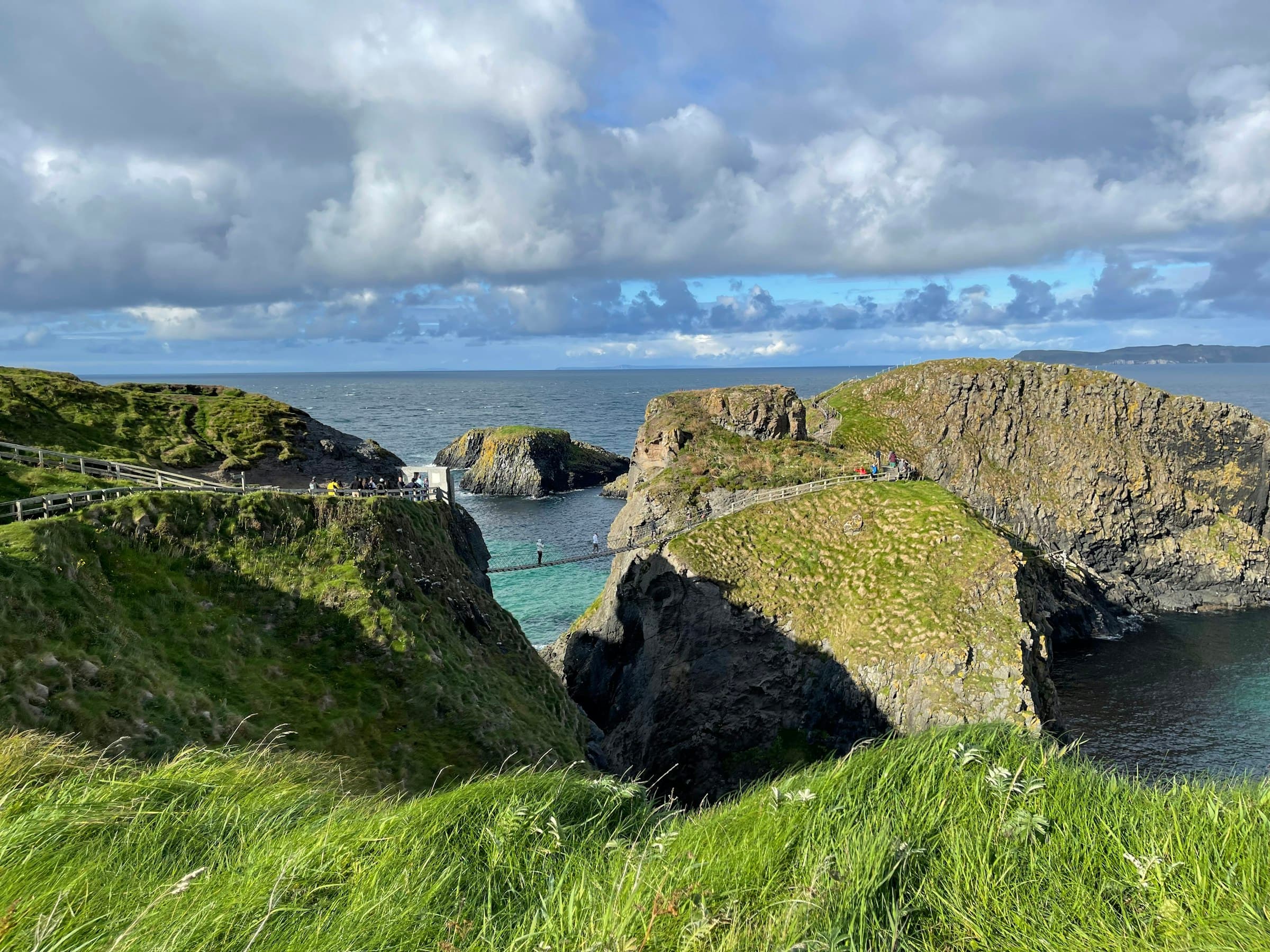
To the north are the Glens of Antrim, an area with strong historic connections to Scotland. From viewpoints such as Torr Head, the Scottish coast is remarkably close on a clear day.
It is easy to understand, standing there, why people and ideas moved back and forth across the North Channel for centuries.
County Down
To the south, the Ards Peninsula and Strangford Lough were important areas of early settlement.
This is the landscape where many of the first Scottish settlers established communities in the early 17th century, and it can be particularly rewarding for families whose research points to County Down.
Tyrone and Derry
For families with roots further west, the journey continues into Tyrone and Derry.
The landscape becomes quieter and less visited, with small market towns, farmland and Presbyterian churchyards where Scottish surnames can still be found on gravestones.
For an ancestry trip, that slower pace can be an advantage. There is more room to explore the particular places that emerge from your research rather than simply following the usual tourist route.
Following the Story Back to Scotland
For those who want to complete the story, the Scottish connection often leads back to Ayrshire and Galloway in the south-west of Scotland.
Ayr, Girvan and Stranraer are among the places associated with the communities from which many settlers travelled to Ulster.
The landscape is very different from the Highlands: rolling farmland, market towns and coastal scenery, all within sight of Ireland across the North Channel.
Standing at the Mull of Galloway, the southernmost point of Scotland, and looking towards Northern Ireland gives you a particularly clear sense of the geography involved.
This was not an ocean crossing. It was a short journey between neighbouring shores that had been connected by trade, migration and family ties for generations.
A trip that begins in Belfast, spends five or six days following the Ulster Scots story in Northern Ireland, and then crosses to Ayrshire for a few days of Scottish research can therefore make historical sense.
You are, quite literally, following the route your ancestors took - only in reverse.
Why This Is a Different Trip from a Typical Irish Ancestry Journey
If you arrive in Ireland expecting the history and emotional landscape associated with Irish Catholic ancestry - the Famine, abandoned townlands and the mass emigration from the west of Ireland - Northern Ireland will tell you a different story.
The Ulster Scots experience is not the same.
The Scottish settlers who arrived in Antrim and Down during the Plantation period came as settlers rather than refugees. Their arrival was part of a wider process of land settlement that profoundly affected the existing population.
Their descendants later left for America for a range of reasons, including economic hardship and religious restrictions. Their story is therefore one of settlement, displacement and migration, rather than a single episode of mass departure.
Northern Ireland also contains several layers of history at once: the Gaelic Irish world that existed before the Plantation, the Ulster Scots communities established during the 17th and 18th centuries, and the more recent political and social history of the 20th century.
Understanding those layers can make the landscape - and the later history of Northern Ireland - much easier to understand.
You may also encounter something particularly striking in Presbyterian churchyards across Antrim and Down: continuity.
The surnames on the gravestones are not simply historical names. Some of the families who remained in Ulster are still represented in the area today.
The Armstrongs, Wilsons, Boyds and other families did not all leave.
Their descendants are still there.
For some ancestry travellers, that can create a connection that is difficult to find elsewhere: not simply a place where an ancestor once lived, but a community where the family name has continued across generations.
Practical Details
When to go
The same general seasons work well for an Ulster Scots ancestry trip as they do for Ireland and Scotland: May to June and September to October.
Northern Ireland is relatively quiet outside the main summer period, and these months can offer a good balance of weather, daylight and visitor numbers.
Archives operate throughout the year, but check opening hours and access arrangements before travelling, particularly around public holidays.
How long you need
For a Northern Ireland-focused ancestry trip, allow at least six or seven nights if you want time for both archive research and regional exploration.
If you want to follow the Scottish side as well, allow another three or four nights.
A combined itinerary of around ten to twelve nights gives you enough time to experience both sides of the story without spending the entire trip moving between locations.
Before you travel
PRONI’s eCatalogue is well worth exploring before your trip. It can help you identify relevant records and give you a clearer idea of what may be available when you arrive.
The Presbyterian Historical Society of Ireland can also be a useful starting point. If you know the general area where your ancestors lived, contact them in advance to find out which congregation records survive.
The more specific you can be about the county, parish or Presbyterian congregation before you arrive, the more productive your time in Belfast is likely to be.
A note on surnames
Many Ulster Scots surnames are also common in Scotland and the Republic of Ireland.
Patterson, for example, appears across all three regions. So the presence of a particular surname in Ireland does not, by itself, establish that a family was of Irish Catholic origin.
The religious denomination associated with the family’s records can be much more revealing. Presbyterian, Catholic and Church of Ireland records may point towards very different family histories.
Surname, place and denomination are therefore best considered together rather than in isolation.
Where This Leads
Scots-Irish ancestry is ultimately a story of migration - of families who moved from Scotland to Ulster and, in many cases, from Ulster to America.
Understanding that journey as more than a sequence of dates and places is what makes an ancestry trip worthwhile.
Many people begin this research knowing only that their family was “Irish”, “Scottish” or “Scotch-Irish”. By the end, they may have something much more specific: a particular community, a particular place and a clearer sense of the decisions that carried their family from one country to another over several generations.
The records can help you reconstruct that journey.
The landscape lets you experience it.
If that is the story you want to trace, we would love to hear what you already know about your family’s history.
Related reading:
Tracing Your Scottish Roots: A Guide